
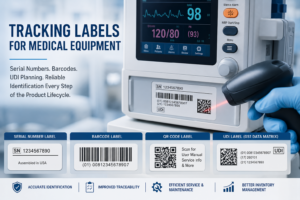
Medical equipment manufacturers rely on tracking labels to identify products, support inventory management, simplify maintenance records, and improve lifecycle visibility. Whether you’re labeling diagnostic equipment, surgical devices, laboratory instruments, or electronic assemblies, selecting the right combination of serial number labels, barcode labels, QR code labels, and UDI labels is key to a successful identification strategy.
A well-planned labeling program helps manufacturers organize production data, simplify field service, and support medical equipment tracking throughout a product’s lifecycle. While every application has unique requirements, thoughtful planning can help improve long-term readability, durability, and scanning performance.
Why Tracking Labels Matter for Medical Equipment
Medical devices often move through manufacturing, distribution, hospitals, service providers, and maintenance programs before reaching the end of their lifecycle. At every stage, accurate identification connects equipment to important production, service, and inventory information.
Modern medical traceability solutions commonly support:
- Product identification
- Manufacturing records
- Inventory management
- Preventive maintenance
- Field service documentation
- Warranty tracking
- Equipment lifecycle management
- Asset management
Durable healthcare identification labels help ensure that critical information remains readable despite repeated cleaning, handling, transportation, and routine use. They also support more efficient maintenance, inventory control, and equipment management.
Common Use Cases for Tracking Labels
Different medical products require different identification methods. Many manufacturers combine multiple variable data elements on a single label to support tracking throughout the equipment lifecycle.
Serial Number Labels
Serial number labels provide every device with a unique identifier. This allows manufacturers and healthcare providers to connect equipment with production history, service records, calibration information, and maintenance schedules.
Typical uses include:
- Medical instruments
- Diagnostic equipment
- Imaging systems
- Patient monitoring devices
- Laboratory analyzers
Barcode Labels
Barcode labels remain one of the most widely used identification methods for medical equipment tracking. Linear barcodes are simple, reliable, and compatible with many inventory management systems.
They can help simplify: 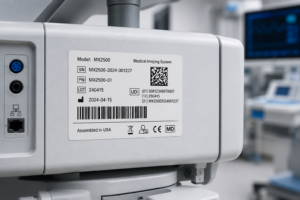
- Inventory control
- Warehouse operations
- Equipment check-in and check-out
- Preventive maintenance programs
- Asset management
QR Code Labels
When additional data needs to fit within a compact space, QR code labels provide a practical solution.
QR codes may link users to:
- Digital manuals
- Maintenance instructions
- Calibration records
- Service portals
- Training resources
Because QR codes store more information than traditional linear barcodes, they are often selected for compact medical devices and equipment with limited labeling space.
UDI Labels
Many medical devices require UDI labels (Unique Device Identification) as part of their product identification strategy. A UDI typically includes both human-readable information and machine-readable data encoded in a barcode or Data Matrix symbol.
Manufacturers should determine which labeling approach best fits their products and intended markets while following applicable regulatory requirements.
When required, UDI information may also be submitted to the Global Unique Device Identification Database (GUDID) to support product identification and regulatory reporting.
Build a Data Model Before Designing Labels
Before selecting materials or printing methods, determine exactly what information each tracking label should contain. A consistent data model simplifies manufacturing, inventory management, maintenance, and product identification throughout the equipment lifecycle.
Common data fields include:
| Data Element | Purpose |
| Serial Number | Unique equipment identification |
| Part Number | Product configuration |
| Lot or Batch Number | Manufacturing traceability |
| Manufacturing Date | Production records |
| UDI | Device identification |
| Barcode or QR Code | Fast, accurate scanning |
| Revision Level | Product version control |
Planning your data model early helps ensure every label supports the information your production, quality, and service teams need.
Choosing the Best Label Format
No single label format works for every medical device.
When selecting tracking labels, manufacturers should evaluate: 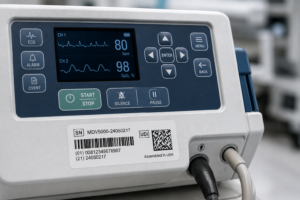
- Available label space
- Scanner compatibility
- Required data capacity
- Environmental exposure
- Cleaning procedures
- Expected product lifespan
- Variable data requirements
Many applications combine:
- Human-readable text
- Linear barcodes
- Data Matrix symbols
- QR codes
- Logos
- Permanent serial numbers
Working with an experienced labeling partner can help optimize label layout while maintaining readability and scanning performance.
Durability and Scan-Grade Testing
Medical equipment labels often experience years of handling, repeated cleaning, and exposure to demanding environments. Selecting durable materials helps preserve both printed information and barcode readability throughout the product lifecycle.
Depending on the application, manufacturers may evaluate:
- Polyester materials
- Polycarbonate constructions
- High-performance adhesives
- Chemical resistance
- Abrasion resistance
- Moisture resistance
- Temperature exposure
- UV exposure
For equipment that requires long-term identification, durable inventory labels help maintain legibility throughout manufacturing, installation, and routine service.
In addition to material selection, barcode verification and scan-grade testing can help confirm that printed codes remain readable throughout manufacturing and normal use. Verification should be evaluated based on the application’s scanning requirements and quality objectives.
Frequently Asked Questions
What are tracking labels?
Tracking labels identify products using unique information such as serial numbers, barcodes, QR codes, or UDI data. They help manufacturers and healthcare providers track equipment throughout its lifecycle.
What is the difference between a barcode and a QR code?
Linear barcodes typically store smaller amounts of identification data and work well for inventory applications. QR codes can store more information within a compact area and may also link users to digital manuals, maintenance records, or service documentation.
What are UDI labels?
UDI labels contain a Unique Device Identifier used to identify many medical devices. Depending on the product and applicable regulations, UDI information may also be associated with records in the GUDID.
How long should medical equipment labels last?
Label durability depends on the application, environmental conditions, cleaning procedures, and material selection. Choosing the right materials and adhesives helps maintain readability throughout the product’s expected service life.
Plan Your Medical Tracking Labels for Long-Term Performance
Effective tracking labels combine durable construction with accurate variable data, clear barcode formatting, and application-specific design. Whether your application requires serial number labels, barcode labels, QR code labels, or UDI labels, thoughtful planning helps support reliable medical equipment tracking throughout the product lifecycle.
NFI manufactures durable identification products for demanding medical and industrial environments. From variable data labels to complete medical traceability solutions, our team helps manufacturers select materials, formats, and printing technologies that meet their application requirements while supporting long-term identification performance.
Contact NFI to discuss durable labeling solutions for your equipment, asset tracking, or traceability program.