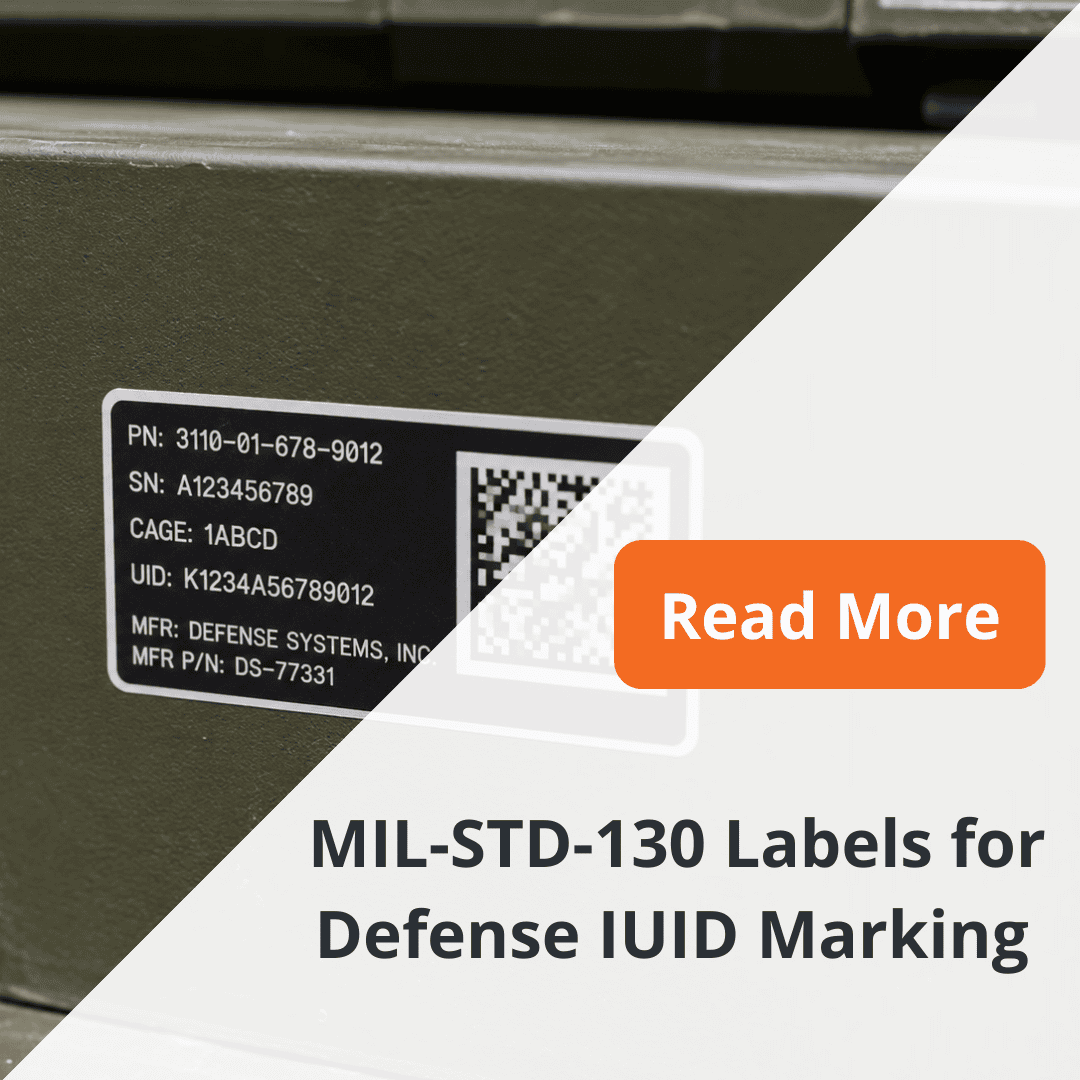
MIL-STD-130 labels help identify military property at the item level. People use them on equipment, parts, assemblies, and assets that need clear, durable marking over time. For defense suppliers, the main value is simple. The right label keeps the item traceable through production, delivery, use, repair, and disposal.
MIL-STD-130 is different from MIL-STD-129. MIL-STD-129 focuses on shipment and storage marking. MIL-STD-130 focuses on identification marking for U.S. military property, including free text and machine-readable information. The official standard scope says it provides item marking criteria for military property produced, stocked, stored, and issued by or for the Department of Defense.
NFI supports military and aerospace manufacturers with durable mil spec labels, barcode labels, serial number labels, and custom nameplates for demanding identification needs. NFI’s MIL-SPEC page notes support for military standard labels, nameplates, faceplates, overlays, and related graphic solutions.
Standard Scope: What MIL-STD-130 Labels Cover
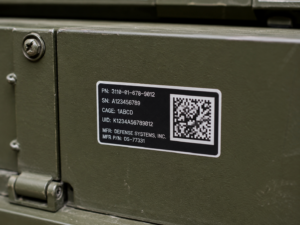
MIL-STD-130 labels may support item identification, UID labels, IUID labels, serial number marking, and machine-readable data. In many defense programs, the label or nameplate must connect the physical item to a unique item identifier, often called a UII.
IUID stands for item unique identification. It helps the DoD and suppliers track specific items, not just part numbers or product groups. DoD Instruction 8320.04 covers item-level data, IUID 2.0 UII construction, and automatic identification technology for data capture from the item or packaging.
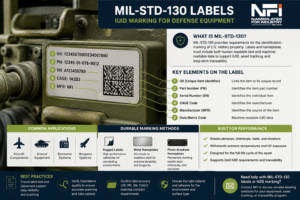
A MIL-STD-130 marking may include human-readable text, a UID Data Matrix code, part number, serial number, CAGE code, manufacturer identification, or other data called out by the contract. The exact content should come from the contract, drawing, purchase order, and current standard.
Durable marking methods may include rugged identification labels, metal nameplates, photo-anodized plates, polyester labels, aluminum labels, or other constructions. The best method depends on the surface, exposure, expected service life, and available marking space.
Spec/RFQ Checklist + Docs for MIL-STD-130 Labels
A strong RFQ helps avoid delays. Before ordering defense equipment labels or mil spec nameplates, gather the details that affect design, production, and validation.
Include these items in your spec package:
- Current drawing or label artwork
- Contract or purchase order marking clause
- Required standard and revision
- Part number, serial number, CAGE code, and UID data
- Human-readable text requirements
- Data Matrix format requirements
- Label size and available marking area
- Surface material and finish
- Indoor, outdoor, chemical, abrasion, UV, or temperature exposure
- Adhesive, fastener, or nameplate mounting method
- Quantity, serialization range, and variable data file
- First article, inspection, or documentation needs
This checklist matters because MIL-STD-130 labels are not one-size-fits-all. A small electronic part may need a compact UID label. A large defense asset may need a metal nameplate with human-readable text and a scannable code. A high-wear application may need a stronger material or protective construction.
NFI’s barcode labels page notes experience with 2D barcode labels, UID, UDI, GS1 DataMatrix, variable data, and custom barcode work. NFI’s asset and inventory tags page also highlights custom wording, barcodes, serial numbering, and indoor or outdoor use for asset tags.
Validation, Testing + Audit Pitfalls
Validation helps confirm that the mark can be read and used. For military barcode labels and IUID labels, the Data Matrix code must be accurate, scannable, and tied to the right item data.
Common audit pitfalls include incorrect data order, wrong serial number, missing contract details, poor barcode contrast, low print quality, damaged labels, and labels that do not match the drawing. Another issue is choosing a label that looks good at delivery but does not hold up in the field.
Testing should match the application. A defense label may need to resist abrasion, cleaning chemicals, fuels, sunlight, heat, cold, moisture, or repeated handling. NFI’s labels page notes durable labels for aircraft, machinery, medical devices, and heavy-use products, with adhesive options for different surfaces.
Buyers should also confirm who owns final compliance review. NFI can help produce rugged identification labels, UID labels, asset tracking labels, and mil spec nameplates based on supplied requirements, but the buyer should verify the current contract, drawing, and applicable standard before release.
FAQ
- What are MIL-STD-130 labels?
MIL-STD-130 labels are item identification labels or nameplates used for U.S. military property. They may include human-readable text and machine-readable codes for defense traceability.
- Are IUID labels and UID labels the same thing?
They are closely related terms. IUID refers to item unique identification. UID labels often refer to labels that carry the unique item identification data, such as a UID Data Matrix code.
- What is the best material for defense equipment labels?
The best material depends on the application. Surface type, exposure, abrasion, chemicals, heat, UV, and expected service life all affect the choice.
- Do all MIL-STD-130 labels need a barcode?
Not every marking need is the same. Many IUID applications use a machine-readable Data Matrix code, but the contract and drawing should define the exact requirement.
Conclusion
MIL-STD-130 labels help defense suppliers mark items for long-term identification, asset tracking, and traceability. The key is to match the label data, material, marking method, and validation process to the contract and application.
Contact NFI to discuss durable labeling solutions for your equipment, asset tracking, or traceability program.