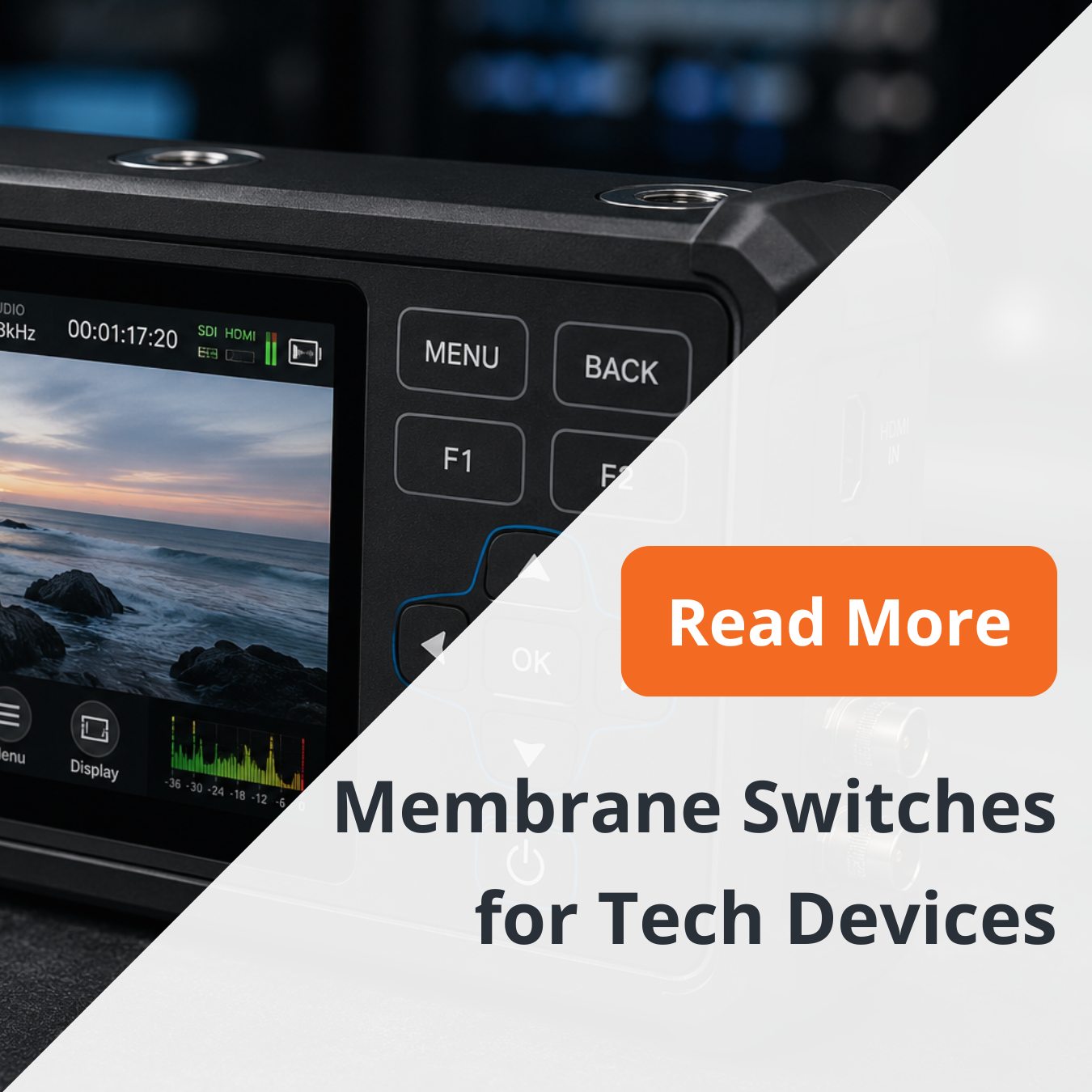
Technology products often need a control interface that delivers several functions within very limited space. Membrane switch panels allow engineers to combine electrical switching, graphics, tactile controls, and other interface elements in a thin custom assembly.
That makes them useful for professional electronics, communication equipment, instrumentation, controllers, and other products where the interface needs to fit the equipment rather than force the equipment to fit a standard switch.
Why Engineers Choose Membrane Switch Panels
A conventional control panel may require separate switches, labels, wiring, and mounting features.
A membrane switch panel brings many of these functions together.
The result is a low-profile interface that can be designed around the dimensions, graphics, electrical requirements, and user interaction of the product.
These membrane switches for demanding applications can be configured according to the equipment rather than selected from a fixed catalog of switch layouts.
Low-Profile Controls for Compact Equipment
Product packaging is an important constraint in electronic equipment.
Displays, circuit boards, connectors, batteries, housings, and thermal requirements already compete for internal space. The operator interface therefore needs to use its available area efficiently.
A low-profile membrane switch can provide multiple keys without requiring the depth associated with an array of conventional mechanical switches.
The exact construction depends on the enclosure, available mounting surface, electrical architecture, and desired user experience.
Tactile and Non-Tactile Options
A membrane switch panel can be designed around different types of key feedback.
Tactile keys provide physical confirmation when pressed. Non-tactile interfaces can provide a flatter response where physical feedback is less important or where another form of confirmation is available.
The decision should be based on how users interact with the equipment.
Key spacing, force, shape, frequency of use, operator environment, and visual feedback should all be considered when defining the interface.
Backlighting and Visual Communication
Some technology interfaces need to remain readable under changing lighting conditions.
Backlighting can be considered as part of the interface architecture where the application requires illuminated keys, symbols, or indicators.
The design needs to coordinate the graphic overlay, illuminated areas, switching geometry, and underlying electronics.
Backlighting should therefore be planned during interface development rather than added after the membrane switch panel has already been finalized.
The Graphic Overlay Is Functional
A membrane switch overlay does more than provide color and branding.
It identifies controls and communicates information to the operator. It may define individual key areas, symbols, windows, indicators, warnings, or operating zones.
For technical products, clarity and consistency matter.
Artwork should therefore be developed with the mechanical and electrical switch design so the visible interface corresponds precisely to the control geometry beneath it.
Integrating the Panel Into the Product
Membrane switch design and enclosure design are closely connected.
The engineer needs to consider panel dimensions, edge conditions, surface geometry, tail routing, connector position, mounting method, windows, displays, and other components that pass through or sit behind the interface.
A switch panel that works electrically but conflicts with the enclosure is not a successful HMI design.
Early coordination makes it easier to identify those constraints before the equipment reaches the final production stage.
Environmental Requirements
Technology and communication equipment can operate in very different conditions.
Some interfaces remain inside controlled indoor environments. Others may face dust, moisture, handling, abrasion, repeated cleaning, or other exposure.
Materials and construction should therefore reflect the actual operating environment.
Where shielding or sealing is required, those requirements should also be defined during the engineering stage.
From Prototype to Production
A new membrane switch panel is often part of a broader product development program.
During the prototype and NPI stages, engineering teams can evaluate key layout, tactile feel, graphics, dimensions, electrical behavior, and integration with the equipment.
The objective is to identify interface issues before the design is committed to production.
For existing products, the same process can be used to evaluate an existing switch that needs to be updated, reproduced, or sourced differently.
A Custom Interface for a Custom Product
Membrane switch panels are most valuable when the interface is treated as part of the equipment rather than as a separate accessory.
By engineering the switching, graphics, mechanical interface, and user requirements together, product teams can create a control surface designed specifically for the device.
More technical guidance: Technical Resources.