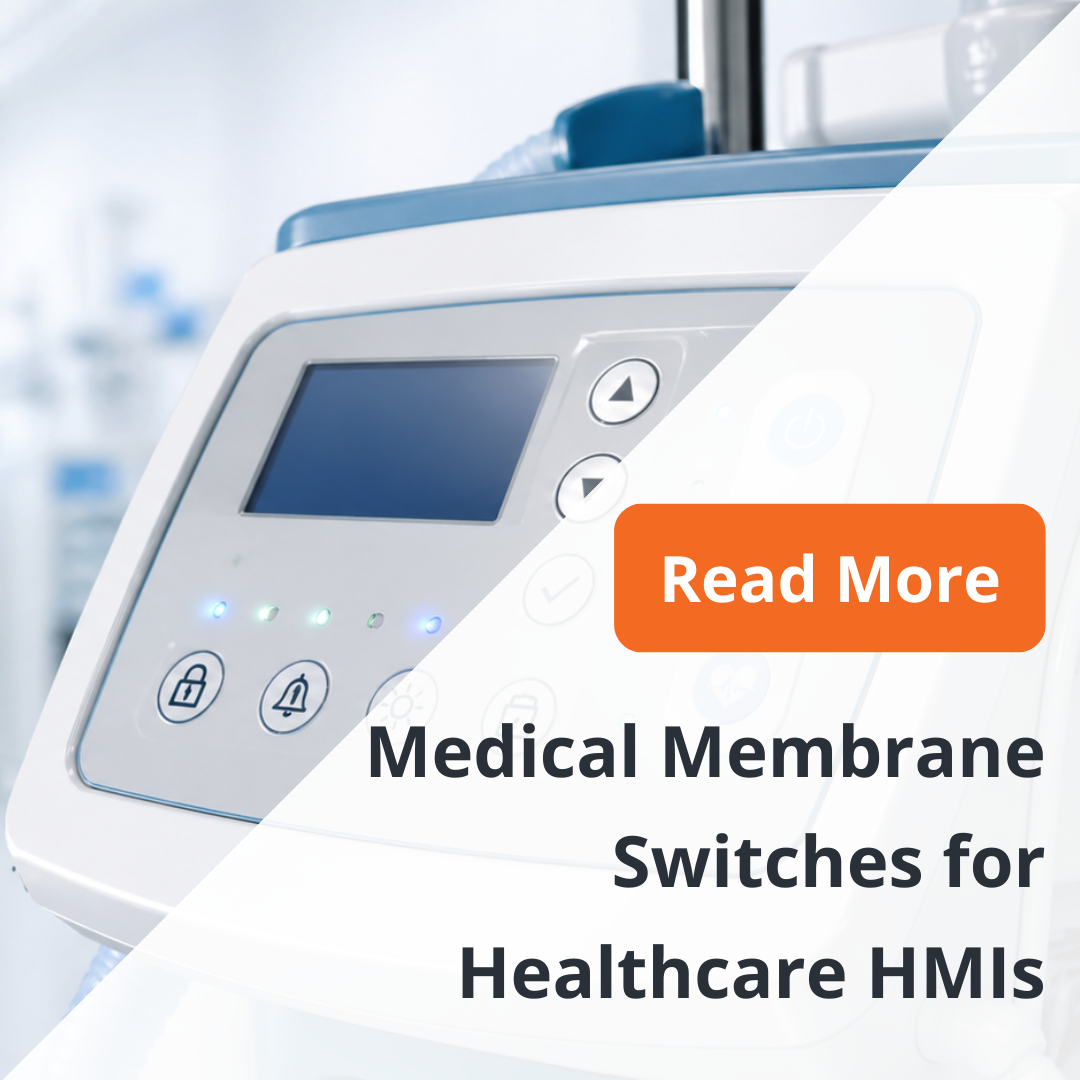
Medical equipment interfaces need to be easy to operate while fitting into products that may be cleaned frequently, handled repeatedly, and expected to perform consistently throughout their service life.
Medical membrane switches provide engineers with a low-profile HMI platform that combines controls, graphics, and electrical switching functions into a single custom assembly.
The objective is not simply to make the interface thin. Its construction must match the equipment, its users, its environment, and the way the device will be maintained.
Why Use Medical Membrane Switches?
A membrane switch allows multiple interface elements to be integrated into one assembly.
Instead of combining separate labels, individual mechanical switches, and decorative panel components, an engineered membrane interface can incorporate keys, graphics, circuitry, windows, indicators, and other features into a unified control surface.
This can be particularly useful for equipment where space is limited or where a smooth, cleanable interface is desirable.
NFI’s broader low-profile HMI controls provide the underlying membrane switch platform that can then be adapted to medical equipment requirements.
Cleanable Interfaces Begin With the Construction
Cleaning requirements should be considered during the design stage.
A smooth graphic overlay and controlled interface geometry can reduce the number of exposed gaps and separate components around the operating surface. The complete assembly can then be designed around the product enclosure and the cleaning conditions expected in use.
The correct solution depends on the equipment. Cleaning procedures, chemical exposure, enclosure geometry, key configuration, adhesives, and interface edges can all influence the final construction.
A cleanable membrane switch therefore needs to be treated as part of the equipment design, not simply as a graphic applied at the end of the project.
Sealed Membrane Switch Designs
Medical equipment may be used in environments where liquids, cleaning agents, or contaminants need to be considered.
A sealed membrane switch design can help engineers manage those exposure requirements by controlling how the layers, edges, tail, and enclosure interface are constructed.
The appropriate sealing approach depends on the application. A design intended for occasional surface cleaning may not require the same construction as an interface subjected to repeated aggressive cleaning or greater environmental exposure.
NFI works from the application requirements to determine which design features are appropriate.
Tactile Feedback and Operator Interaction
Tactile response is an important part of HMI design.
A tactile membrane switch can give the operator physical confirmation that a key has been pressed. In other applications, a non-tactile interface may provide the preferred user experience.
The decision should consider operator workflow, key size and spacing, gloves if relevant to the application, visual feedback, and the equipment’s broader interaction design.
Because the graphical and electrical interface are engineered together, labels, symbols, key locations, and tactile response can be coordinated as part of the same control panel.
Graphics Are Part of the HMI
Clear graphics help users understand the equipment and identify controls quickly.
A medical membrane keypad may include legends, symbols, status areas, windows, colors, or other visual cues according to the approved equipment design.
The objective is functional clarity, not decoration.
For engineering teams, the artwork should therefore be developed alongside the switch geometry rather than after electrical decisions have already been completed.
Designing for the Equipment, Not Just the Switch
Every medical HMI sits inside a larger mechanical and electronic system.
Dimensions, mounting surface, cable routing, connector location, display integration, enclosure transitions, and available internal space can all affect the membrane switch design.
Early collaboration between the equipment designer and membrane switch manufacturer can help identify these constraints before tooling or final production decisions are made.
This is especially important during new product introduction, when changing an interface late in development can affect several other components.
New Design or Existing Interface?
Medical membrane switch projects do not always start from a blank sheet.
An OEM may need a completely new HMI for a new device, an updated interface for an existing product, or an alternate manufacturing source for a switch already in use.
The engineering process should identify the functional requirements in each case: dimensions, circuitry, tactile behavior, graphics, environmental exposure, and connection method.
A replacement interface should be evaluated functionally rather than only copied visually.
What to Provide When Discussing a Medical Membrane Switch
Useful project information includes drawings, dimensions, existing artwork, circuit requirements, number of keys, tactile preferences, connector requirements, cleaning conditions, enclosure information, and any existing interface that needs to be evaluated.
The more clearly the operating environment and interaction requirements are defined, the easier it becomes to establish an appropriate construction.
Engineering the Complete Interface
Medical membrane switches bring together electrical switching, graphics, mechanical integration, user interaction, and environmental considerations.
For medical device design teams, the strongest approach is to treat the membrane switch as part of the complete HMI system from the beginning of development.
More technical guidance: Technical Resources.