When production equipment needs attention, maintenance teams need to identify the correct machine, component, service information, and maintenance history quickly.
Poor, damaged, missing, or inconsistent identification adds friction to that process.
Industrial labels cannot eliminate every cause of downtime, but a clear and durable identification system can support maintenance teams by making the information attached to equipment easier to find, read, and use.
Why Equipment Identification Matters During Maintenance
A plant may contain hundreds or thousands of machines, panels, tools, components, and assets.
When equipment requires inspection or repair, technicians need confidence that they are working on the correct asset.
That is where maintenance labels, equipment IDs, serial information, asset tags, and service labels become part of the maintenance workflow.
Clear identification can reduce unnecessary manual lookups and help connect the physical equipment to the corresponding maintenance information.
For applications requiring purpose-built identification, NFI supplies custom industrial labels designed around the equipment and its operating environment.
Labels Need to Remain Readable Where the Equipment Operates
A maintenance label is useful only while the information remains legible and attached.
Industrial equipment may be exposed to abrasion, oils, cleaners, chemicals, moisture, outdoor conditions, or repeated handling.
The appropriate label construction therefore depends on the environment.
A label used on indoor equipment in a controlled area may require a different material and adhesive system from one used on machinery exposed to chemicals or regular wash-down.
Specifying the environment before production helps align the label construction with the application.
Where the right construction is not obvious from the specification alone, maintenance teams can Request Relevant Samples and evaluate candidate materials and adhesives against the conditions the equipment actually faces.
Preventive Maintenance Labels
Preventive maintenance depends on performing the right activity at the right time.
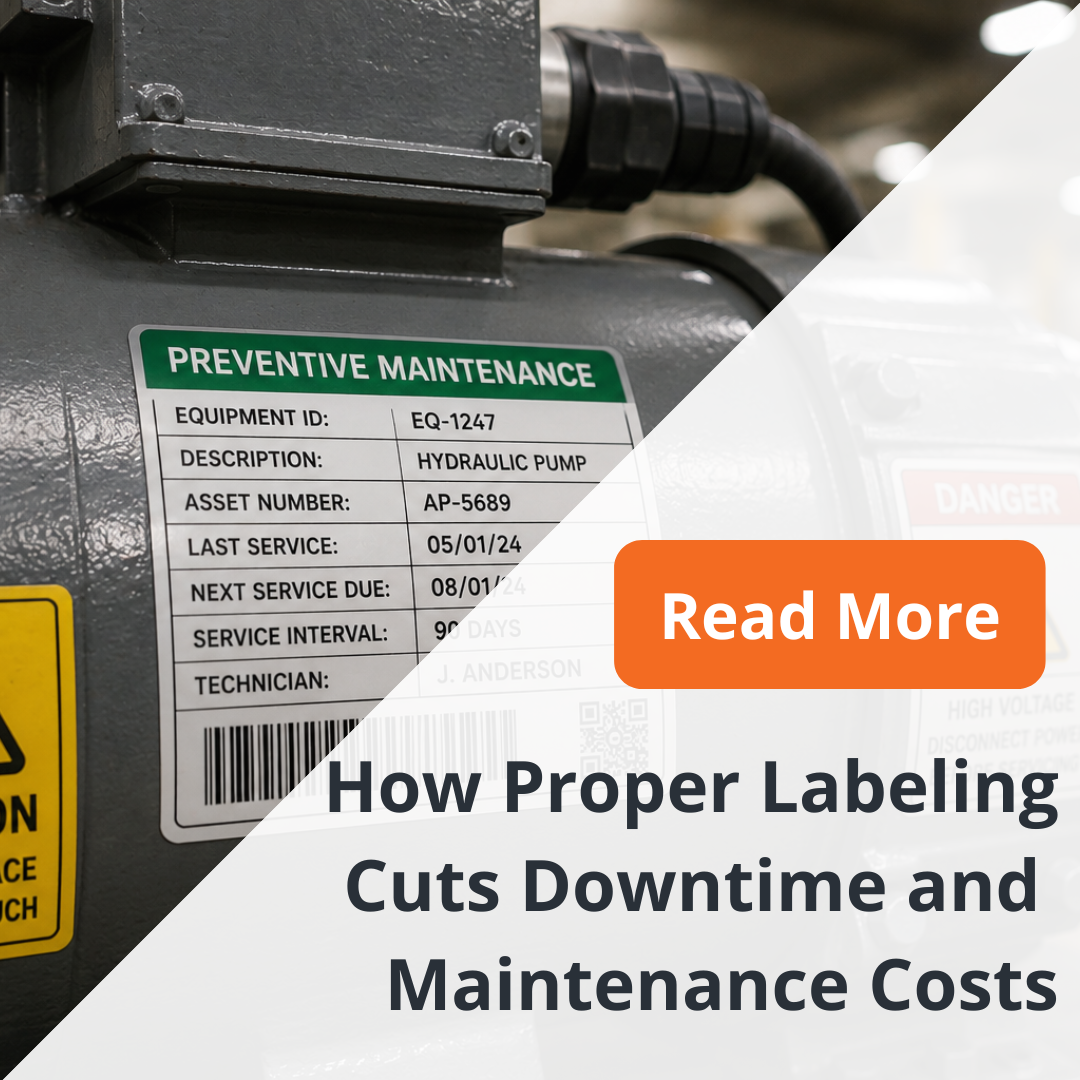
Preventive maintenance labels can provide visible information directly on or near the equipment, helping operators and technicians identify service requirements, inspection status, or other maintenance-related information defined by the organization.
The label should complement the maintenance process rather than replace the underlying maintenance system.
Where digital records are used, the physical identification can also provide the reference that connects the machine to the correct record.
Maintenance Tags and Service Labels
Different maintenance workflows require different types of identification.
Permanent equipment labels may identify the asset throughout its service life. Service labels or maintenance stickers may provide inspection, service, or maintenance information. Tags may be appropriate for other operational uses.
The design should reflect how the information is updated, who needs to read it, how long it needs to remain in place, and what environment it will face.
A maintenance label that is difficult to read or located where technicians cannot see it adds little value to the workflow.
Supporting Maintenance Records
Many organizations maintain digital service records for their equipment.
The physical asset still needs a reliable identifier that allows the technician to connect the machine in front of them with the correct information in the system.
Serial numbers, equipment IDs, barcodes, QR codes, or other machine-readable identifiers can all play a role depending on the maintenance architecture.
The correct format depends on the systems already in use and the information that needs to be retrieved.
Avoiding Identification Errors
Maintenance work often happens under time pressure.
Consistent asset identification can make it easier for technicians to distinguish between similar pieces of equipment, identify the correct component, and confirm that the maintenance record matches the physical asset.
This is particularly relevant in facilities with repeated machine models, multiple production lines, or equipment that moves between locations.
The goal is not to add more labels. It is to make the necessary identification unmistakable and useful.
Label Design for Maintenance Teams
A good maintenance label starts with the information the technician actually needs.
Important considerations can include label size, viewing distance, typography, asset numbering, machine-readable codes, material, adhesive, placement, and exposure conditions.
The design should also consider whether labels need to remain readable after repeated cleaning or prolonged industrial use.
A highly durable label with poorly organized information still creates a usability problem.
When Existing Labels Fail
A maintenance labeling problem often becomes visible only after the equipment has been in service.
Labels may become difficult to read, detach, fade, or no longer match the organization’s maintenance process.
When that happens, replacing the label with the same construction may simply reproduce the problem.
The useful question is why the existing identification is failing.
Is the issue abrasion? Chemical exposure? Adhesion? Cleaning? Incorrect material? Placement? Changing maintenance requirements?
Understanding the failure mode helps define a more appropriate replacement.
Maintenance Identification as Part of Equipment Reliability
Reliable maintenance depends on much more than labels.
But equipment identification is one of the small operational details that must work consistently if technicians are expected to move efficiently between physical equipment and maintenance information.
Choosing the right industrial labels, maintenance tags, and service identification can make that connection clearer and more dependable.
More technical guidance: Technical Resources.