
Aerospace equipment needs labels that last. These labels display serial numbers, part numbers, safety details, and other important information.
Poor aerospace label design can lead to peeling, fading, or unreadable markings. This makes equipment harder to identify and track.
The good news? Many label problems can be avoided before production.
Here are seven common mistakes and how to prevent them.
Why Does Aerospace Label Design Matter?
Aerospace labels may face heat, cold, moisture, chemicals, and regular handling.
If a label fails, maintenance teams may struggle to identify equipment or read important information.
The right material, adhesive, and printing method can help prevent these problems.
Good label design starts with understanding where and how the equipment will be used.
7 Aerospace Label Design Mistakes to Avoid
- Choosing the Wrong Label Material
Not every material works in every environment.
Polyester labels can offer good chemical and temperature resistance. Metal nameplates may be better when equipment needs rigid identification.
How to avoid it: Check the operating conditions before choosing the material.
- Ignoring the Equipment Surface
Labels do not stick equally well to every surface.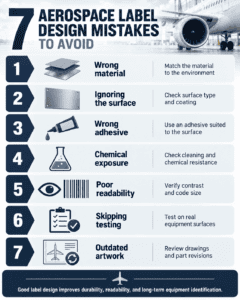
Smooth metal, painted panels, and textured plastic may need different adhesives.
Powder-coated surfaces can be harder to bond because of their texture and finish.
How to avoid it: Identify the surface material and coating before selecting the adhesive.
- Using the Wrong Adhesive
A strong adhesive is not always the right adhesive.
Some adhesives work well on smooth metal but may not bond properly to certain plastics or coatings.
This can cause peeling or edge lift over time.
How to avoid it: Choose an adhesive made for the equipment surface and expected conditions.
- Overlooking Chemicals and Cleaning
Aerospace equipment may come into contact with oils, cleaners, and other chemicals.
These substances can damage some labels, inks, or adhesives.
Frequent cleaning may also cause printed information to wear away.
How to avoid it: Choose suitable materials and protective layers. Test them against the chemicals used during maintenance.
- Making Labels Hard to Read
Small text, poor contrast, or crowded layouts can make labels difficult to read.
Barcodes and Data Matrix codes may also fail to scan when they are too small or poorly printed.
This can slow down equipment tracking and repairs.
How to avoid it: Use clear text, good contrast, and enough space around codes. Check readability before production.
- Skipping Prototype Testing
A label may look good on a computer but fail on actual equipment.
Heat, moisture, cleaning, and surface texture can affect its performance.
Testing a sample helps reveal problems before a large order is made.
How to avoid it: Test prototypes on the real equipment surface under expected conditions.
- Forgetting About Design Changes
Equipment designs can change during development.
Part numbers, serial number formats, and label sizes may also change.
Without proper updates, labels may contain incorrect information.
How to avoid it: Review drawings, artwork, and part revisions before approving production.
How Can Engineers Prevent Aerospace Label Failures?
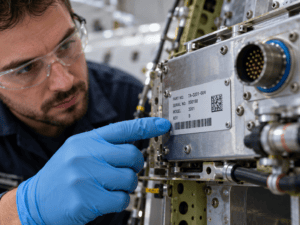 A simple review can help prevent costly mistakes.
Before ordering aerospace labels, check:
- Equipment surface and coating
- Temperature and chemical exposure
- Material and adhesive selection
- Text and barcode readability
- Label size and placement
- Prototype testing needs
- Final artwork and part numbers
These checks help teams select labels that fit the equipment and its service conditions.
What Should You Ask an Aerospace Label Manufacturer?
Choosing the right supplier is just as important as choosing the material.
Ask whether the manufacturer can review your application, suggest materials, and provide samples.
You should also discuss adhesive options, printing methods, and any required testing.
NFI manufactures custom aerospace labels, nameplates, and durable identification products.
Its team can help review material choices, adhesives, and label designs before production.
Frequently Asked Questions
What causes aerospace labels to peel?
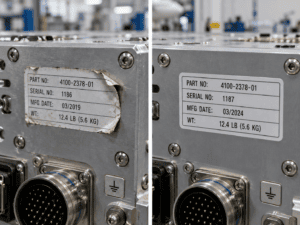
Peeling can result from the wrong adhesive, a dirty surface, or exposure to heat, moisture, and chemicals.
Are polyester labels suitable for aerospace equipment?
They can be. Polyester offers useful durability for many applications, but the exact material must match the equipment’s conditions and requirements.
Should aerospace labels be tested before production?
Testing is recommended when durability or adhesion is critical. It helps identify possible problems before full production.
Improve Aerospace Label Design With NFI
Good aerospace label design starts with the right material, adhesive, and layout.
Avoiding common mistakes can help labels stay readable and reduce the need for replacement.
NFI works with aerospace manufacturers to create durable labels and identification products for demanding applications.
Contact NFI to discuss aerospace label materials, adhesives, and prototypes for your next project.