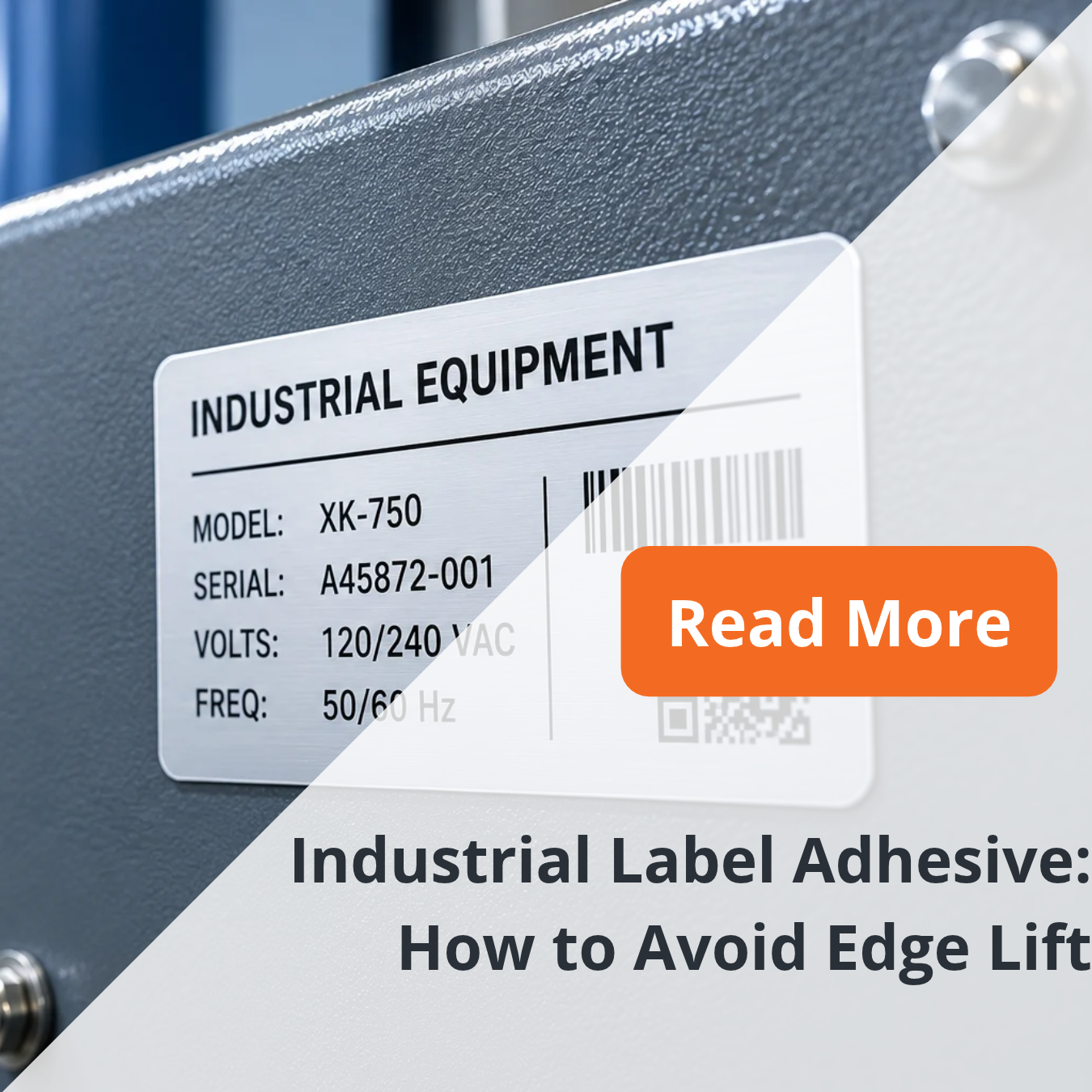
Choosing the right industrial label adhesive is critical when labels must stay bonded to powder-coated metal or low-surface-energy (LSE) plastics. These surfaces can create adhesion challenges that lead to edge lift, curling, or complete label failure.
The solution starts before a label reaches the equipment. Substrate properties, surface condition, adhesive chemistry, label construction, and the operating environment all affect long-term performance. For manufacturers that need durable identification, matching these factors can help create permanent industrial labels designed for the application.
Substrate & Surface Energy
Surface energy describes how readily an adhesive can wet out, or spread across and make close contact with, a substrate. In general, higher-surface-energy materials are easier to bond than low-surface-energy materials. 
Plastics such as polyethylene (PE) and polypropylene (PP) can present adhesion challenges because of their low surface energy. A standard adhesive that performs well on metal may not develop the same bond on these plastics. A low surface energy adhesive may be needed to improve initial tack and long-term adhesion.
Powder-coated surfaces present a different challenge. Although the underlying substrate may be metal, the adhesive bonds to the powder coating—not the metal itself. Texture, coating chemistry, gloss level, additives, and surface contamination can all affect adhesion.
For powder coated labels, surface texture deserves special attention. A rough or heavily textured coating reduces the effective contact area between the adhesive and the surface. If the adhesive cannot flow into the surface profile, gaps can form along the label perimeter and increase the risk of edge lift.
Surface Preparation Matters
Even a well-matched adhesive can fail on a poorly prepared surface. Dust, oils, release agents, cleaning residues, and other contaminants can interfere with the adhesive bond.
Proper surface preparation should be established for the specific substrate and application. This may include cleaning the surface with an appropriate method and allowing it to dry fully before applying the label.
Application temperature and pressure also matter. Applying a label outside the adhesive’s recommended temperature range can limit initial bonding. Firm, even pressure helps the adhesive make better contact with the substrate.
Adhesive Selection Framework for Industrial Label Adhesive
There is no single industrial label adhesive that is ideal for every application. Adhesive selection should start with the substrate and then account for the conditions the label will face.
A useful selection framework considers:
- Substrate: Is the label bonding to metal, powder coat, painted material, polypropylene, polyethylene, or another plastic?
- Surface texture: Is the surface smooth, lightly textured, or heavily textured?
- Environment: Will the label encounter heat, cold, moisture, chemicals, UV exposure, or outdoor weather?
- Service life: Does the application require temporary identification or permanent industrial labels?
- Label construction: How does the facestock, adhesive, size, shape, and thickness affect the finished label?
- Application conditions: At what temperature and with what pressure will the label be installed?
These variables work together. For example, a thicker or more conformable adhesive layer may help on some textured surfaces, while a specially formulated low surface energy adhesive may be better suited for difficult plastics.
Label geometry can matter as well. Sharp corners can create stress points where lifting begins. Depending on the application, rounded corners and appropriate label dimensions can support edge lift prevention.
This systems-based approach is especially important for equipment labels exposed to repeated handling, cleaning, vibration, temperature changes, or outdoor conditions.
Peel/Shear + Environmental Testing
Adhesive specifications are useful for narrowing the options, but application-specific testing provides a better indication of how a label construction may perform on the actual product.
Peel and shear testing evaluate different aspects of adhesive performance. Peel testing measures the force needed to remove a bonded label from a surface at a defined angle and rate. Shear testing evaluates the adhesive’s ability to resist forces acting parallel to the bonded surface. 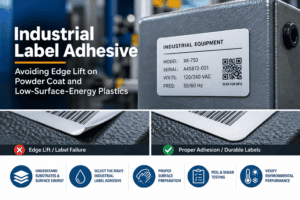
Both can provide valuable information when comparing potential durable adhesive labels.
Testing should use representative production surfaces whenever possible. A sample of the actual powder-coated panel or molded plastic component can reveal issues that may not appear when testing on a smooth laboratory substrate.
Environmental conditions should also be considered. Depending on the end use, testing may evaluate exposure to:
- Elevated or low temperatures
- Temperature cycling
- Humidity and moisture
- UV or outdoor conditions
- Oils, cleaners, or other chemicals
- Abrasion and repeated handling
The appropriate test plan depends on the application. Testing does not automatically guarantee performance in every environment, but it can help manufacturers identify potential label failure before moving into full production.
Prevent Label Failure Before Production
Successful adhesion is the result of more than choosing a “strong” adhesive. The substrate, surface energy, texture, contamination, environment, label construction, and application process all influence the final bond.
For powder coat and LSE plastics in particular, early evaluation can make a major difference. Careful adhesive selection, consistent surface preparation, proper application, and relevant peel, shear, and environmental testing can help reduce edge lift and support long-term identification.
NFI works with industrial manufacturers to develop durable identification solutions based on the requirements of the application. Selecting the right industrial label adhesive as part of the complete label construction can help equipment labels remain readable and securely bonded in demanding environments.
Contact NFI to discuss durable labeling solutions for your equipment, asset tracking, or traceability program.
Frequently Asked Questions
What causes industrial labels to lift at the edges?
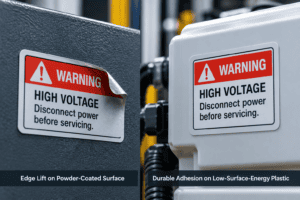 Edge lift can result from poor adhesive wet-out, surface contamination, low surface energy, textured surfaces, incorrect application temperature, environmental exposure, or stress from the label construction.
What adhesive works on low-surface-energy plastics?
Polyethylene, polypropylene, and similar materials may require an adhesive specifically formulated for LSE substrates. The correct choice depends on the plastic, surface condition, operating environment, and required service life.
Do powder-coated surfaces require special label adhesives?
They can. Powder coating chemistry and texture affect the surface the adhesive must bond to. Testing the proposed label and adhesive on the actual powder-coated component is recommended when long-term adhesion is critical.
How can manufacturers reduce industrial label failure?
Start by identifying the substrate and environment, select a compatible adhesive, establish consistent surface preparation and application procedures, and test the complete label construction under representative conditions.