
OEM machine controls need interfaces that remain readable, responsive, and dependable through repeated use. Industrial membrane switches provide a compact machine control interface that can combine graphics, switching functions, tactile feedback, backlighting, and environmental protection into one assembly.
Reliability, however, depends on more than choosing a membrane keypad. OEM teams should evaluate the complete construction and operating environment before moving from prototype to production. The following checklist highlights key factors to discuss with your membrane switch manufacturer.
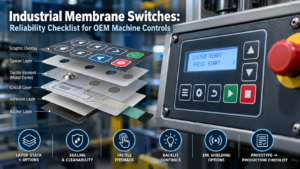
Industrial Membrane Switch Layer Stack + Options
A membrane switch is built from multiple functional layers. The exact construction varies by application, but a typical stack may include a graphic overlay, adhesive layers, spacer, circuit layers, tactile components, and a rear adhesive for mounting.
The graphic overlay is the surface operators see and touch. It can include printed legends, symbols, colors, transparent windows, textured areas, and other visual features needed for the equipment control panel.
Below the overlay, the circuit layer creates the electrical switching function. A tactile membrane switch may use metal domes or other design features to provide physical feedback when an operator presses a key. This response can be valuable when users need confirmation that an input has been made.
OEMs should also consider options such as: 
- Backlit controls for low-light environments or status indication
- Embossed keys to help operators locate control areas
- Windows for LEDs or displays
- Custom colors, icons, and branding
- Connectors and tail configurations suited to the equipment
- EMI shielding membrane switch designs where electromagnetic interference is an application concern
Each feature can affect the switch construction, thickness, appearance, tooling, and production requirements. Defining these needs early can help reduce redesigns later in the project.
Sealing/Cleanability + Reliability of Industrial Membrane Switches
A sealed membrane switch can help protect the control interface from contaminants that may affect conventional mechanical controls. This makes membrane switches useful for industrial equipment exposed to dust, moisture, oils, cleaning processes, or frequent operator contact.
The correct sealing strategy depends on the actual environment. Engineers should identify expected contaminants, cleaning chemicals, temperature conditions, exposure duration, and whether the interface will be used indoors or outdoors.
Cleanability is another important consideration. A flat or low-profile membrane switch keypad has fewer gaps and openings than many assemblies built from individual mechanical buttons. That can simplify routine wiping and cleaning.
Reliability also depends on material selection and construction. Before specifying a durable keypad, consider:
Actuation frequency: How often will operators press each key?
Tactile requirements: Does the operator need a noticeable snap or response?
Chemical exposure: Will cleaners, lubricants, solvents, or other substances contact the surface?
Temperature: What operating and storage temperature ranges should the assembly support?
Lighting: Does the industrial HMI require illuminated keys, symbols, or status indicators?
Electrical environment: Is shielding needed to address EMI or electrostatic discharge considerations?
Environmental sealing and durability requirements should be evaluated for the specific application rather than assumed from the membrane switch format alone.
Prototype->Production RFQ Checklist
A detailed request for a quote helps a manufacturer understand how the machine control interface needs to perform. Providing requirements early can also make prototype evaluations more useful and support a smoother transition into production.
Before submitting an RFQ for industrial membrane switches, OEM teams should provide as much of the following information as possible:
- Overall dimensions and available mounting area
- Number, size, and location of keys

- Graphic artwork, legends, colors, and branding requirements
- Tactile versus non-tactile key preferences
- Expected actuation or lifecycle requirements
- Required connector and circuit tail configuration
- Backlighting or indicator requirements
- EMI or shielding considerations
- Operating and storage temperatures
- Expected moisture, dust, chemical, and UV exposure
- Cleaning procedures and cleaning agents
- Surface texture and finish preferences
- Display or indicator windows
- Mounting surface and adhesive requirements
- Prototype quantities and estimated production volumes
- Relevant drawings, specifications, and testing requirements
OEM teams should use prototypes to evaluate more than appearance. Test key feel, readability, fit, connector location, installation, lighting, and interaction with the complete equipment enclosure whenever possible.
Building a More Reliable Industrial HMI
The best membrane switch design starts with the conditions the operator and equipment will actually face. Layer construction, tactile response, sealing, cleanability, lighting, shielding, and mounting all influence how an interface performs in its intended application.
NFI works with OEMs to develop durable identification and interface components for demanding industrial equipment. By defining requirements early and reviewing the complete industrial membrane switch as part of the equipment control panel, manufacturers can make better-informed decisions from prototype through production.
Contact NFI to discuss durable membrane switch and machine control interface solutions for your OEM equipment.
Frequently Asked Questions
What are industrial membrane switches?

Industrial membrane switches are thin, multi-layer user interfaces that combine printed graphics with electrical switching functions. They can be designed with tactile keys, lighting, windows, shielding, and environmental sealing for OEM equipment.
What makes a membrane switch suitable for industrial equipment?
Suitability depends on the application. Material selection, circuit construction, sealing, tactile requirements, chemical exposure, temperature, lighting, and expected usage should all be considered when specifying the switch.
Can a membrane switch include backlit controls?
Yes. Depending on the design, membrane switches can incorporate backlighting or indicator lighting to improve visibility and communication equipment status.
When should an OEM consider EMI shielding?
EMI shielding may be considered when electromagnetic interference could affect the interface or surrounding electronics. Shielding requirements should be reviewed as part of the complete electrical and mechanical design.