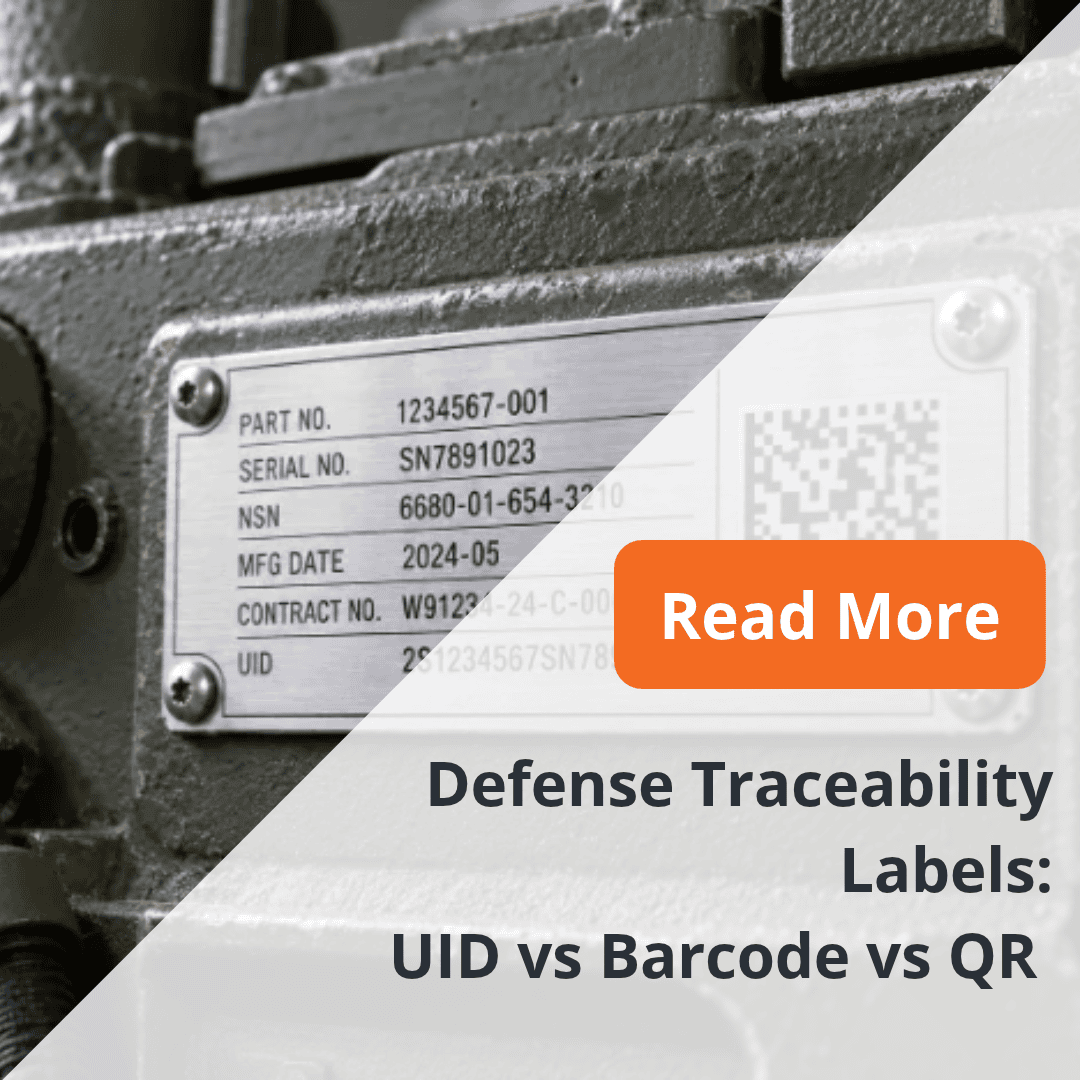
Military and aerospace equipment needs clear, reliable identification. Defense traceability labels help teams track assets, manage repairs, and keep records accurate throughout an asset’s life.
Three common options are UID labels, traditional barcodes, and QR codes. Each serves a different purpose.
Understanding these differences helps defense manufacturers choose labels that fit their equipment, tracking systems, and project needs.
UID vs Barcode vs QR: Key Differences
UID, barcode, and QR labels all store information that scanners can read. However, they work best for different tasks.
| Label Type | Main Purpose | Common Use |
| UID Data Matrix | Give each item a unique identity | Military equipment identification |
| Barcode | Track assets and inventory | Parts, tools, and storage |
| QR Code | Link equipment to digital records | Maintenance and service information |
The right choice depends on how the equipment is used and tracked.
What Are UID Labels Used For?
UID stands for Unique Identification. The Department of Defense (DoD) uses Item Unique Identification (IUID) to help identify certain military assets.
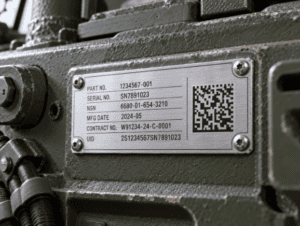 A UID label usually includes a two-dimensional Data Matrix code. This code holds information used to identify an individual item.
UID labels help defense teams:
- Track equipment through its service life
- Keep records for individual parts
- Support maintenance and repair tracking
- Manage equipment transfers
- Reduce identification errors
For example, a military aircraft component may need a UID mark that stays readable through years of use and repair.
MIL-STD-130 sets marking rules for certain U.S. military property. Not every asset requires a UID label. Requirements depend on the contract and equipment.
When Should You Use Barcode Labels?
Traditional barcode labels make daily asset tracking easier.
A scanner reads the barcode and sends its information to an inventory system. This helps teams track tools, parts, and equipment.
Barcode labels are useful for:
- Warehouse inventory
- Tool tracking
- Spare parts management
- Equipment check-in and check-out
For example, a military maintenance team can scan a barcode to record when a tool leaves or returns to storage.
Barcodes work well with many existing tracking systems. However, a standard barcode does not replace a required DoD UID mark.
How Do QR Codes Help Track Military Equipment?
QR code labels connect physical equipment to digital information.
When a technician scans a QR code, it can open an approved maintenance record, service guide, or inspection form.
This makes it easier to find the right information without searching through paper records.
For example, an aerospace maintenance team might use QR codes to access approved service instructions.
QR codes are helpful for:
- Maintenance records
- Inspection forms
- Equipment manuals
- Service history
However, QR codes do not replace UID labels when DoD IUID marking is required.
For military applications, any linked information should follow the organization’s security rules.
Why Does Label Durability Matter?
Military equipment often works in harsh conditions. Labels may face heat, moisture, chemicals, rubbing, and repeated handling.
A damaged label can become difficult to scan. This may slow down repairs or make tracking harder.
That is why defense traceability labels need materials suited to their environment.
Common options include:
- Polyester labels for suitable industrial applications
- Aluminum nameplates for demanding conditions
- Durable adhesives selected for the equipment surface
The best material depends on the asset, its operating conditions, and its expected service life.
Which Defense Traceability Labels Should You Choose?
The best label depends on what you need to track. 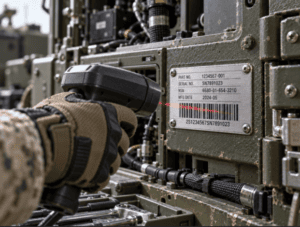
Choose UID labels when equipment must meet DoD IUID marking requirements.
Choose traditional barcodes for everyday inventory, warehouse tasks, and tool tracking.
Choose QR codes when teams need quick access to approved digital records.
Some equipment can use more than one format.
For example, a military asset may use a UID Data Matrix for required identification and a separate QR code for maintenance information.
This helps teams handle different tracking tasks without relying on one code for everything.
Frequently Asked Questions
Is a UID label the same as a QR code?
No. A UID Data Matrix supports a defined system for identifying individual items. A QR code often links to digital information. They use different code formats. 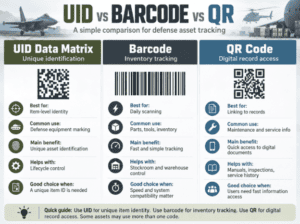
Are UID labels required on all military equipment?
No. UID requirements depend on the equipment, contract, and applicable DoD rules.
Can equipment have both UID and QR labels?
Yes. UID can support required item identification, while QR codes can provide access to approved maintenance records.
What makes a good military asset label?
A good label stays readable in its intended environment. Material, adhesive, print quality, and placement all matter.
Choose the Right Defense Traceability Labels With NFI
The right defense traceability labels make it easier to identify, track, and maintain military and aerospace equipment.
UID labels support unique item identification. Barcodes help manage inventory. QR codes provide access to digital records.
NFI offers durable identification solutions, including UID labels, barcode labels, serialized labels, and asset tags for demanding applications.
Contact NFI to discuss durable labeling solutions for your military equipment, aerospace assets, or traceability program.